
Why Your Urban Fleet's Tires Fail Early: A Load-Index Fix That Extends Lifespan
An urban delivery van or taxi that wears out a set of tires in half the mileage its operator expected usually does not have a rubber problem. It has a specification problem: the load index and the maximum inflation pressure moulded into the sidewall do not match the loads the vehicle actually carries on the routes it actually runs.
Load index is the code that states the maximum load a single tire is designed to carry at its rated inflation pressure. Maximum pressure is the ceiling the casing can safely hold — not a daily operating target. On commercial van sizes such as SMARTWAY II (5.00R12 ULT) and 155R12C, that information appears as a load index pair (for example 106/104) together with a maximum pressure marking (for example 450 KPa). When both are matched to real axle loads and to an urban stop-start duty cycle, most of the failure modes that shorten urban tire life stop repeating.
This article is written for fleet managers, taxi and ride-hailing operators, van distributors and tyre distributors who buy passenger car tires for city duty. It explains what early urban tire failure actually looks like, what the sidewall codes mean, how to run a load-matching procedure step by step, and where each decision changes the three-year cost of a fleet.
Problem Definition: What "Early Failure" Actually Means on an Urban Van
Early tire failure on urban commercial vehicles shows up in a small number of recognisable ways, and almost all of them trace back to the load and pressure relationship rather than to the tread pattern.
- Sidewall bulging or a knot after a kerb strike or pothole impact. The sidewall loses a cord and the casing deforms locally. Once that happens, the tire is finished, regardless of remaining tread depth.
- Irregular and shoulder-focused wear. Wear concentrates on the shoulders instead of sitting flat across the tread, which is the classic footprint of a casing running under-inflated for the load it is carrying.
- Premature replacement across a whole fleet. Multiple vehicles from the same depot failing in the same mileage band is a specification signal, not a driver signal.
- Heat-related failures on hot afternoons. Repeated deflection under load generates heat, and heat is what converts a marginal under-inflation into a structural failure.
Three mismatches drive these outcomes. The first is choosing a load index intended for the passenger version of a vehicle rather than the loaded commercial version — a van at full payload is a different tire problem from the same van empty. The second is setting pressure by feel or by comfort rather than by the load the tire has to carry. The third is ignoring the duty cycle: urban routes combine kerbs, potholes, constant stop-start, door-to-door delivery and short heat cycles, and that combination stresses the sidewall far more than the tread.
Industry Background: Why Load-Carrying Capacity Is Now the Deciding Variable
The commercial context behind this problem is straightforward. According to Grand View Research, the global passenger car tire market was valued at approximately USD 143.06 billion in 2024, with the passenger car segment leading the total tire market with a 32.6% revenue share. Volume of that scale means the difference between a correct and an incorrect load index is not a niche technical detail — it is a purchasing decision made thousands of times a day.
Two structural trends make load and pressure matching more important than it used to be.
Vehicles are getting heavier per axle. Precedence Research projects the global electric vehicle tire market to reach USD 337.20 billion by 2034, growing at a CAGR of 28.1% from 2025, driven specifically by requirements for high load capacity and low noise. Electrified taxis and electric delivery vans add battery mass to the same urban duty cycle, which pushes the required per-tire load capacity upward while leaving the urban kerb-and-pothole environment unchanged.
Regulation now touches performance, not just dimensions. Passenger car tires must comply with UN Regulation No. 117 (ECE R117), which sets limits for rolling resistance, wet grip and external rolling noise, including mandatory labelling in the EU. For a fleet buyer, that means the specification conversation is no longer only about size; it also covers what the SKU has been approved to do in the market where it will be used.
Supply scale also matters when a fleet or distributor standardises a casing across a region. China's total tire exports in 2025 reached 9.65 million tonnes, a 3.6% increase year-on-year, with an export value of approximately 167.7 billion RMB (around USD 23.1 billion), which reflects how global the sourcing of fleet tires has become. Shandong Wideway Tire Co., Ltd., which manufactures the WIDEWAY, EVERLAND and V-RICH brands, operates a 1,000,000 sqm facility with an annual capacity of 23.4 million units and exports 70% of its production, serving markets that include Central and South America, Canada, the EU, Africa, the Middle East, Southeast Asia, Central Asia and Australia.
The Load-Index Fix: Reading the Sidewall Before You Order
The markings that decide whether an urban fleet tire survives
Every tire carries the same four pieces of information, and urban fleets usually only read the first one.
- Size code. A size such as 155R12C reads as a 155 mm section width, radial construction, 12-inch rim diameter, with the C indicating a commercial, reinforced casing intended for load-carrying use. A size such as 5.00R12 ULT uses an inch-based section width with a radial casing and a light-truck designation. Both sit in the same urban van and light commercial class, and both exist because that class needs more load capacity than a standard passenger casing of the same footprint.
- Load index pair. A marking such as 106/104 is not two ratings for one tire; it is one rating for single fitment and a lower rating for dual fitment. Dual fitment reduces the permissible load per tire because the paired tires run hotter.
- Speed symbol. The letter R indicates the speed capability of the casing. For city and delivery duty, speed is almost never the limiting factor — which is precisely why load index, not speed rating, is the variable urban fleets should be arguing about.
- Maximum pressure. A marking such as 450 KPa is the maximum cold pressure the casing may be inflated to. It is a limit, not a recommendation, and it does not tell a driver what to run at a given axle load.
Why the second number in the load index pair matters
Van and light commercial operators frequently order dual-fitment rear axles and then compare quotes using the single-fitment figure from the same sidewall. That is a specification error with a structural consequence: the tire is inflated and loaded as if it were carrying the higher rating, while the marking on the casing only authorises the lower one in that position. The result is exactly the failure pattern described earlier — sidewall heat, then bulging, then replacement.
Maximum pressure is a ceiling, not a target
Running a tire at its marked maximum pressure for a partial load does not "add safety margin". It changes the footprint, moves wear to the centre of the tread and reduces grip. Running below what the load requires is worse: the casing deflects further with every rotation, heat builds in the sidewall, and a pothole impact that a correctly inflated tire would absorb becomes a cord breakage. The correct figure is the vehicle manufacturer's cold pressure for the actual axle load, and it must never exceed the maximum pressure moulded on the tire.
What construction adds when the specification is already correct
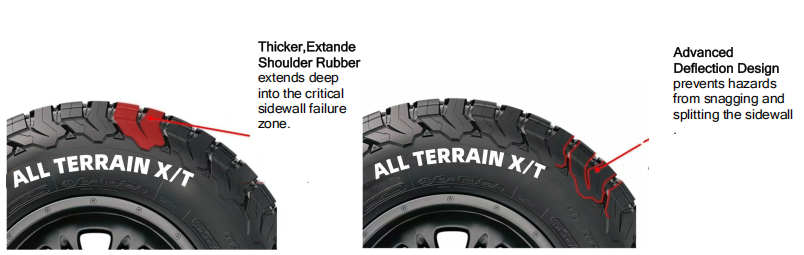
Load matching removes the cause of early failure; construction decides how much punishment the casing can absorb once the load is right. Compared with traditional tire pattern and construction design, the WIDEWAY, EVERLAND and V-RICH construction approach uses tougher sidewall rubber, a thicker and extended shoulder rubber, an advanced deflection design and a silent absorber element.
The measurable effect of that difference, as recorded in the product comparison data, is a tread width with a 3% wider contact patch for enhanced road contact, a sidewall reinforcement of 5 mm additional thickness for maximum impact and blowout resistance, a 22% increase in grip and driving stability, and a 40% extension in total tire lifespan and safety margins. For urban fleets, the 5 mm sidewall reinforcement is the number that matters most: it is the same measure used to control sidewall knots, reducing the risk of sidewall bulging caused by cord breakage when a tire hits a pothole.
A Step-by-Step Load-Matching Procedure for Fleet Managers
This procedure can be run on a single van, a taxi fleet or a distributor's customer base. It replaces opinion with measurement.
- Weigh the vehicle as it is operated, not as it is sold. Load the van with a representative payload and weigh each axle separately. Door-to-door delivery loads are frequently uneven front to rear, and the rear axle is usually the one that fails first.
- Calculate the required load per tire. Divide each axle's weight by the number of tires on that axle. On a single-tire front axle, that is two tires; on a dual rear axle, that is four.
- Add a working margin for real-world conditions. Load distribution is never perfectly even, cornering transfers weight, and heat reduces capacity. Operators generally look for a load index that leaves headroom above the calculated figure rather than one that matches it exactly.
- Read the candidate tire's sidewall. Identify the size code, the load index pair and the maximum pressure. If the vehicle uses dual fitment, use the lower figure in the pair for the rear axle calculation.
- Cross-check the quote against the sidewall. A quote sheet that lists only a size, without the load index and maximum pressure, cannot be verified. Ask for the load index and pressure marking in writing for every SKU on the quotation.
- Set cold inflation to the load, and record it. Use the vehicle manufacturer's pressure for the measured axle load, never exceeding the tire's marked maximum. Record the figure on the vehicle so that drivers and workshops use the same number.
- Re-inspect after the first service interval. Check for shoulder wear, sidewall marking and pressure loss across the fleet. If wear is still irregular after load and pressure have been corrected, the duty cycle has changed and the specification needs re-checking.
The order matters. Fleets that start by choosing a pattern and then look for a load index almost always end up under-specified, because pattern choice is driven by availability and price rather than by axle load.
Use Cases: Where the Load-Index Fix Changes the Fleet's Numbers
Last-mile parcel and grocery vans
These vehicles run the highest number of kerb contacts and pothole impacts per kilometre. They are also the most likely to be loaded to the roof for the return leg. Required load index is set by the fully loaded rear axle, and the 5 mm sidewall reinforcement is what absorbs the urban impact environment.
Taxi and ride-hailing fleets
Passenger-car-based taxis rarely overload, but they accumulate extreme stop-start cycles and long idling periods, and they carry passenger loads on hot urban surfaces. Here the gain comes from matching pressure to the loaded axle weight rather than to a generic "comfort" figure, which is also what protects grip on wet urban asphalt.
Mixed urban and highway courier vans
These vehicles switch between high-temperature highway running and kerb-heavy city delivery on the same shift. Because the same casing must handle both, the load index must be chosen for the heavier of the two duty cycles, and the pressure must be re-checked as the vehicle returns to urban routes.
Electric taxi and electric delivery fleets
Battery mass raises the required per-tire load capacity at all four corners, while removing engine noise makes cabin noise the dominant complaint. The market demand for EV tires is being driven by precisely these two requirements — high load capacity and low noise — and Wideway's specialised product categories include EV-specific models designed for noise reduction and higher load indexes alongside its White Letter and White Wall ranges.
Hot-climate and mountain-adjacent urban routes
Where city routes climb and brake repeatedly, heat accumulates faster and the operating margin between the vehicle's load and the tire's rating narrows. In these conditions the case for a correctly specified load index with reinforced sidewall construction is strongest — the record shows this construction is intended for urban road, highway, all-terrain, mud-terrain, rugged, and snow-and-ice road conditions.
Comparison Table: Under-Specified vs Correctly Specified Urban Fleet Tires
The table below compares the two decisions a fleet actually makes at order stage. It contains no performance figures, because the difference at this stage is a decision difference.
| Decision factor | Under-specified load index | Load index matched to measured axle load |
|---|---|---|
| What is read on the sidewall | Size only; load index pair and maximum pressure treated as administrative detail | Size code, load index pair (single and dual reading) and maximum pressure all verified |
| Cold inflation practice | Set by feel, comfort or workshop habit | Set to the vehicle maker's pressure for the measured axle load, never above the marked maximum |
| Typical failure mode | Sidewall bulging after kerb or pothole impact; irregular shoulder wear | Wear spread more evenly across the tread; fewer impact-related casing failures |
| Replacement pattern | Repeated early replacement across the fleet | Replacement tied to genuine tread wear |
| Structural risk in city conditions | Elevated, because deflection and heat rise whenever load exceeds the casing rating | Managed, because the casing works inside its rated load and pressure envelope |
| Effect on fleet documentation | Specification cannot be verified against a quotation | Load index and pressure are stated in writing for every SKU ordered |
The second table compares the construction of the WIDEWAY, EVERLAND and V-RICH approach with traditional tire pattern and construction design, using the recorded comparison figures.
| Comparison point | WIDEWAY / EVERLAND / V-RICH construction | Traditional pattern and construction design |
|---|---|---|
| Contact patch | Tread width with 3% wider contact patch, for enhanced road contact | Narrower contact patch |
| Sidewall | Sidewall reinforcement of 5 mm additional thickness, for maximum impact and blowout resistance | Standard sidewall thickness |
| Grip and stability | 22% increase in grip and driving stability | Baseline |
| Service life | 40% extension in total tire lifespan and safety margins | Baseline |
| Initial cost | 10% higher initial cost | Lower initial cost |
| Total cost of ownership | 40% lower total cost of ownership over 3 years | Higher three-year cost |
| Maintenance requirement | 90% less maintenance required than traditional alternatives | Higher maintenance load |
| Intended conditions | Urban road, highway, all-terrain, mud-terrain, rugged, snow and ice road conditions | Conventional road use |
Figures in the second table describe construction versus traditional tire pattern and construction design. They are not a substitute for verifying the load index and maximum pressure on the specific size being ordered.
FAQ: Load Index, Pressure and Urban Fleet Decisions
Do urban passenger car and van tires need certification to be sold in the EU?
Yes. Passenger car tires must comply with UN Regulation No. 117 (ECE R117), which sets limits for rolling resistance, wet grip and external rolling noise, including mandatory labelling in the EU, as published by UNECE. In practice, the check a fleet buyer performs is that the exact size and pattern on the quotation carries the required marking for the destination market. Shandong Wideway Tire Co., Ltd. supplies the WIDEWAY, EVERLAND and V-RICH brands to markets that include the EU alongside Canada, Africa, the Middle East, Southeast Asia, Central Asia, Central and South America, and Australia, so SKUs destined for those markets must meet the applicable requirements there. Always confirm the marking for the specific size you are buying rather than assuming it carries across from another size.
Can a thicker sidewall really prevent the bulging that ends urban van tire life?
Sidewall bulging on urban fleets normally starts with cord breakage after a kerb strike or pothole impact, not with tread wear. WIDEWAY's sidewall knot control measure uses a 5 mm thicker sidewall to significantly reduce the risk of sidewall bulging caused by cord breakage when hitting potholes. It is combined with quality testing and customer usage training, so drivers set and maintain the correct cold pressure for the load they actually carry — the reinforcement protects the casing, and the training protects the reinforcement.
Is a correctly specified fleet tire more expensive to run?
On a like-for-like comparison against traditional tire pattern and construction design, the initial cost is 10% higher, but the total cost of ownership is 40% lower over three years, and the product requires 90% less maintenance than traditional alternatives. The saving does not come from a cheaper tire; it comes from a tire that completes its service life instead of being replaced early, and from fewer roadside interventions and workshop hours per vehicle per year.
How can a fleet validate load index and pressure before switching a whole fleet over?
Validate from the vehicle outward. Weigh the loaded vehicle per axle, divide by the number of tires on that axle, compare the result with the load index moulded on the candidate tire's sidewall, and confirm you are using the single or dual rating that matches the fitment. Then set cold pressure to the vehicle manufacturer's figure for that load. Run the check on one van or one taxi before standardising, because a size that works on a light urban route may be under-specified on a loaded delivery round. The EVERLAND CATALOG-2025 is available for download and contains the size and specification data needed for that first comparison.
What affects lead time when a fleet switches to a different load index or casing?
Lead time is driven by size and pattern availability, order volume and the documentation requirements of the destination market — not by the load index itself. Shandong Wideway Tire Co., Ltd. operates a 1,000,000 sqm facility with an annual capacity of 23.4 million units, a 25-person R&D team and a 70% export ratio, which supports volume orders for fleet operators and distributors across six continents; the exact schedule is confirmed per order against the confirmed size list. If you are evaluating a change, send the measured axle loads and the required size list to the WIDEWAY commercial team and ask for the load index and maximum pressure of each proposed SKU in writing before you commit.
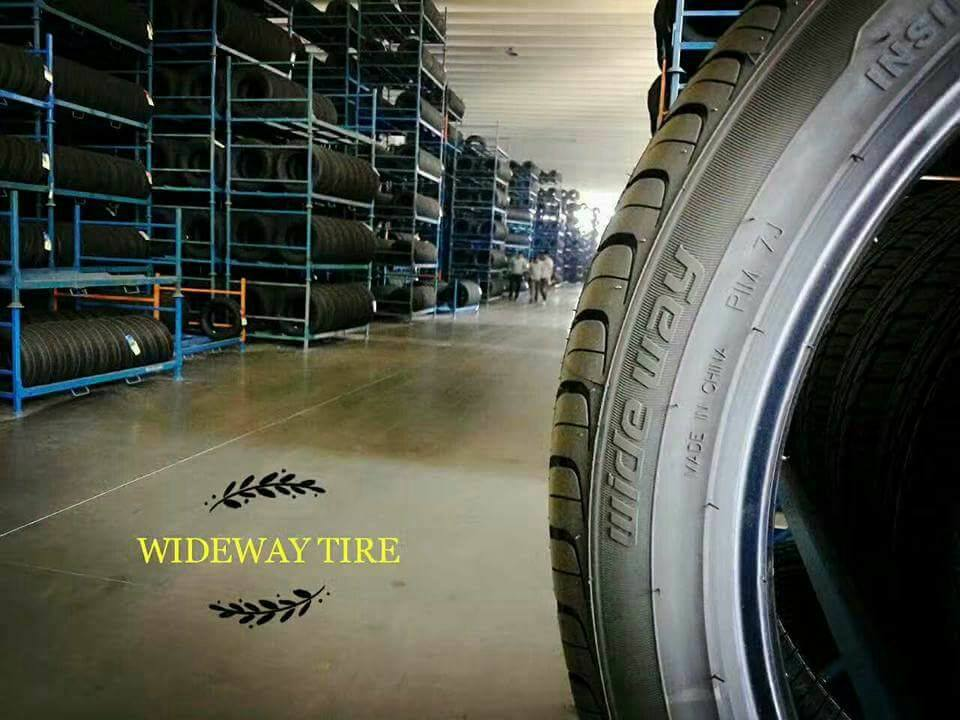
Next step for fleet operators and distributors
Download the EVERLAND CATALOG-2025 for size and specification data, or send your measured axle loads and required size list to the WIDEWAY team for a specification check and quotation.
Contact: Della — della@widewaytire.com · WhatsApp/Tel: +86 18253208831 · Website: www.widewaytire.com
Conclusion: Fix the Specification Before You Change the Tire
Urban fleets that fail tires early are usually not buying bad tires. They are buying tires whose load index and maximum pressure were never matched to the loaded axle weights of the vehicles they go on. That single mismatch produces sidewall bulging after pothole impacts, irregular shoulder wear and a replacement cycle that repeats every few months regardless of brand.
The fix is small and cheap to apply: weigh the vehicle loaded, calculate the per-tire load, read the load index pair and maximum pressure on the sidewall, use the lower figure of the pair where dual fitment applies, set cold pressure to the manufacturer's recommendation for that load, and put the verified figures on the purchase order. Construction then does the rest, and the recorded difference is measurable — a 5 mm thicker sidewall for impact resistance, a 3% wider contact patch, a 22% increase in grip and driving stability, and a 40% extension in total tire lifespan, against 10% higher initial cost and a 40% lower total cost of ownership over three years.
For a fleet, the decision is not "which tire is cheapest today". It is "which correctly specified casing will still be running in year three". Matching load index and pressure is how that question gets answered.
Have Questions or Need More Details?
Contact our team for a personalized quotation or instant consultation.
Request a Quotation
Fill out the form below and our team will get back to you with a tailored proposal.
WhatsApp Direct Chat
Prefer to chat in real-time? Message us on WhatsApp for instant assistance & quick answers.
- Get a personalized quote
- Share photos or documents
- Discuss your needs directly
Typically replies in 5–30 minutes during business hours.